
Dunklin Probation and Parole Compared
Missouri’s Division of Probation and Parole supervises several distinct groups. A court may order probation instead of imprisonment or after a suspended sentence. The Missouri Parole Board may release an eligible state prisoner before the sentence ends. Conditional release also follows prison confinement under a sentence structure. All can involve community supervision, but their legal starting points and decision makers differ.
| Supervision | How it begins | What release means | Who to verify with |
|---|---|---|---|
| Probation | A court order | The person may never enter state prison | MODOC field office and court |
| Parole | A Parole Board order | Prison confinement ends while legal custody continues | MODOC active search, field office, and Board |
| Conditional release | A sentence-based release component | Prison ends and supervision follows | MODOC record and field office |
| Final discharge | Completion or lawful termination | Correctional supervision ends | MODOC records and sentencing court |
RSMo section 217.690 states that a parolee stays in the legal custody of the department and remains subject to Board orders. Parole is therefore not a pardon, clemency, or final discharge. A person can truthfully be released from prison and still appear as an active MODOC offender.
- Field officer
- The probation and parole officer responsible for day-to-day supervision.
- Absconder
- A person alleged to have stopped reporting or left supervision without permission.
- Violation
- An alleged failure to follow a supervision condition.
- Discharge
- The documented end of the correctional sentence or supervision.
Verify Dunklin Post-Release Supervision
The MODOC active offender search is the first public check for a person on probation, parole, or conditional release. The system accepts a name and searches aliases. A MODOC number is the stronger identifier. Its notice also says discharged offenders are excluded and some data may be unavailable for safety, security, or confidentiality reasons.
- Search with the last and first name. Try known aliases and spelling variants.
- Use the MODOC number when available, and compare identifying facts before selecting a result.
- Read status and location together. An institutional location and a field-supervision status mean different things.
- Record the page’s data-current time. A supervision status can change after that point.
- Use the official district directory or MODOC contact path to identify the field office responsible for the person.
- Ask the field officer or caseworker to resolve an ambiguous status. For final discharge, request the release and discharge record.
A no-result search has several possible causes. The person may be fully discharged, listed under a different spelling, excluded from the public view, or never under MODOC authority. Someone who served only a Dunklin County Jail stay may have no state corrections record. Compare the Sheriff’s release route, the Justice Center custody source, and the Dunklin Circuit Clerk record before drawing a conclusion.
Dunklin County Supervision Office
MODOC District 23 gives Dunklin County a named local probation and parole contact. It serves Dunklin, Pemiscot, New Madrid, Scott, and Mississippi counties. Its Kennett Community Supervision Center is supervision infrastructure, not a jail roster or proof that every Dunklin case is assigned there. Verify the actual assignment because an approved plan, residence, case transfer, or interstate arrangement can place responsibility elsewhere.
MODOC District 23, Kennett Community Supervision Center1401 Laura Drive
Kennett, MO 63857
573-888-4900
The official District 23 page pictured below identifies the local office and its regional service area.
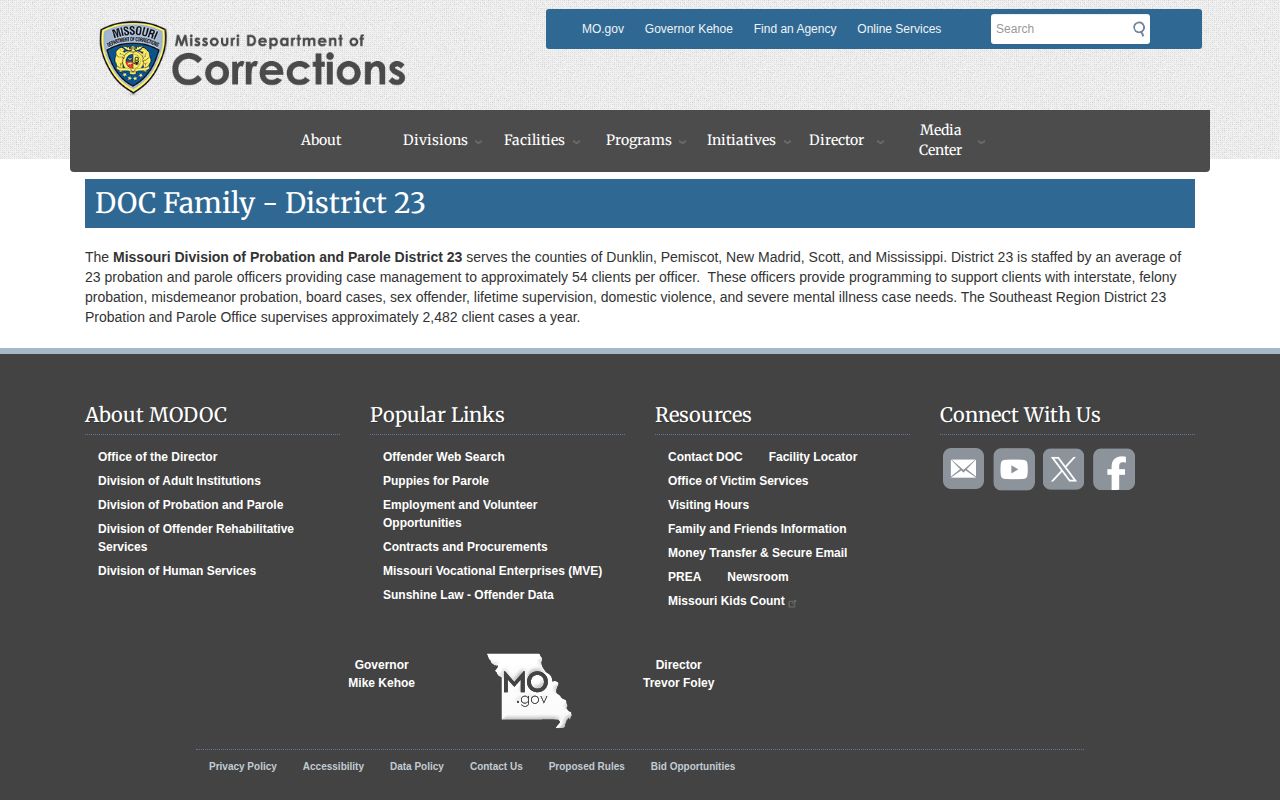
The public page is a routing source. Person-specific reporting duties and release conditions must come from the assigned officer or official record.
Dunklin Parole Release Decisions
The Missouri Parole Board, not the Dunklin County Sheriff or the sentencing judge, decides discretionary parole for eligible MODOC prisoners. Eligibility does not guarantee release. Statutory minimum terms, consecutive sentences, offense rules, institutional conduct, release planning, and Board judgment can all affect the process. The Board may set a presumptive release date, deny release and set a later review, or connect its decision to conditional or maximum release.
The official hearing explanation says a decision commonly takes about eight to twelve weeks after the hearing. That is a decision window, not a fixed prison-door date. A later release-readiness review may approve the plan, change conditions or timing, cancel or reschedule release, or set reconsideration. The active offender record, institutional parole office, or eligible victim-notification route is more useful for a named person than expecting a public monthly decision list.
The Missouri Parole Board publishes its rules, guidelines, contacts, and hearing resources, but the research found no public individualized results database. Board material also has confidentiality limits. The offender receives written action, and eligible registered victims can receive authorized notice. A Sunshine request to the Board remains subject to those restrictions.
The Board’s public resources are shown below as the starting point for process questions.
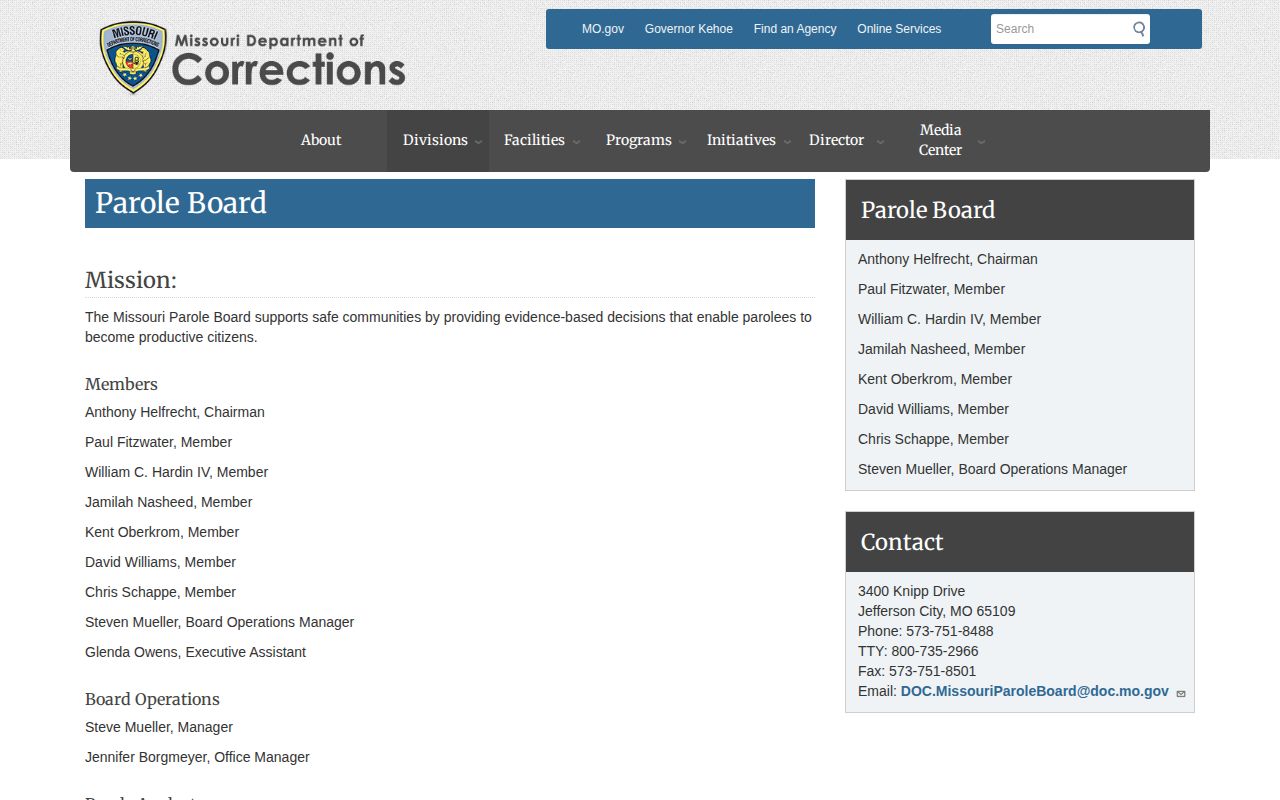
A Board date must still be separated from actual physical release and from the later end of parole supervision.
Dunklin Supervision Violations and Warrants
Conditions are rules attached to supervision. They can concern reporting, approved residence, travel, treatment, fees, or conduct, but the actual order controls. A public search should not be used to invent a condition. Ask the field office or review the court and Board record that applies to the person.
An absconder, violation, or warrant status does not erase the original release. It generally signals that the person first left confinement under supervision and later became subject to an alleged violation or retaking process. Confirm a warrant through the supervising authority and court docket. No official standalone Dunklin County absconder list was found.
Do not read an alleged violation as a conviction or a completed return to custody. Check the current MODOC status and court action.
Current MOVANS can provide agency-fed custody or court notification when a participating record exists. It is not the certified source for supervision conditions. Missouri also warns that an offline local agency can make a person unavailable in MOVANS, so absence from that portal does not prove discharge.
Dunklin Probation and Parole Discharge
Final discharge is different from release from prison or jail. A parolee may leave prison and remain in MODOC legal custody. A probationer may live in the community while a court sentence remains active. Discharge marks the later end of the correctional term or supervision, subject to the governing order and record.
MODOC’s public web search intentionally omits discharged offenders. For an old Dunklin County case, request the commitment date, prison-release or supervision-start date, supervision end, and final discharge from MODOC. Then compare the sentencing case in Case.net. The sheriff’s jail release record proves only the county facility exit, not the end of a state term.
A focused MODOC Sunshine request should include a full name, date of birth, MODOC number if known, sentencing county and case, and approximate custody dates. The MODOC Sunshine page routes department and Parole Board requests to separate custodians. Confidentiality and statutory limits still apply.
Keep the terms precise when records disagree. A court docket may show that probation was ordered or completed, while MODOC holds the supervision dates used by its field system. A Parole Board action may set a future release, yet an institutional event records when confinement actually ended. The final answer may require all three records. Ask each custodian to correct only the entry that office created, and preserve the response date because an active status can change.
Dunklin District 23 Release Role
District 23’s presence in Kennett is a useful local detail, but the phrase “Community Supervision Center” requires care. An assignment there can involve a structured residential setting. It should not automatically be described as unrestricted community living or as continued county-jail confinement. Ask MODOC for the person’s precise status and reporting responsibility.
Specific status questions should go to the institutional caseworker or probation and parole field officer. MODOC’s general contact number is 573-751-2389 when the correct office is unclear. The Missouri Parole Board can be reached at 573-751-8488 for Board process questions, while person-specific access may be limited by law.
Dunklin Post-Release Reentry Network
A District 23 resource guide names a Bootheel network that includes Missouri Reentry Program resources, Dunklin County Caring Council, DAEOC in Kennett, SEMO Health Network Kennett, and Dunklin County Health Department. It is a navigation aid. Resource guides age, and a listed provider’s services, contact details, and eligibility should be confirmed directly before a plan depends on them.
The network does not verify parole, probation, or discharge. That responsibility remains with MODOC and the court. Reentry resources address needs that may follow release, while official supervision records state who is responsible for the case.
Dunklin Release Documents to Keep
MODOC reentry terminology identifies key documents such as a birth certificate, state identification, Social Security card, education credential, and a release or discharge certificate. Keeping the certificate matters because it can distinguish the end of prison confinement from a later supervision discharge. A correction to that state certificate should go through MODOC.
Dunklin County publishes no present jail policy for property return or document pickup. Do not use an old audit finding as current procedure. Ask the county jail directly about identification, receipts, release papers, and any property issue tied to a county booking.
Note: A release certificate may document one correctional event, but it does not replace the court docket or another agency’s separate custody record.